Difficulty Guide
Friendship Peak. Difficulty & preparation.
Assess Friendship Peak difficulty with a practical look at altitude, snow and glacier movement, summit-day demands, prerequisites, fitness, and responsible suitability.
Friendship Peak difficulty: the short answer
Friendship Peak is a 5,289m semi-technical Himalayan climbing objective near Manali. The route is approachable for a fit, prepared trekker under qualified mountain leadership, but it is not a casual trek: altitude, snow and glacier movement, cold, and a long summit day all matter. “Beginner-friendly” describes the progression of the route, not a guarantee that every beginner is suitable.
Use this page to assess prerequisites and preparation. For dates, inclusions, route logistics, and the current expedition format, see the Friendship Peak expedition page.
What makes Friendship Peak difficult?
The current expedition profile describes a compact Manali objective with progressive acclimatisation, snow movement, glacier travel, crampons, an ice axe, rope systems, and a summit ridge. The route rises from Manali through Dhundi, Bakarthach (3,300m), Lady Leg Base Camp (3,900m), and Summit Camp (4,500m) before the summit attempt.
1. Altitude and acclimatisation
At 5,289m, the summit is high enough that sleep, appetite, pace, and recovery can change. The itinerary includes an acclimatisation and mountaineering-training day; the team still has to adjust movement and plans to actual conditions. Previous trekking experience at altitude is useful, but no past result guarantees how an individual will respond.
2. Snow, glacier, and basic rope movement
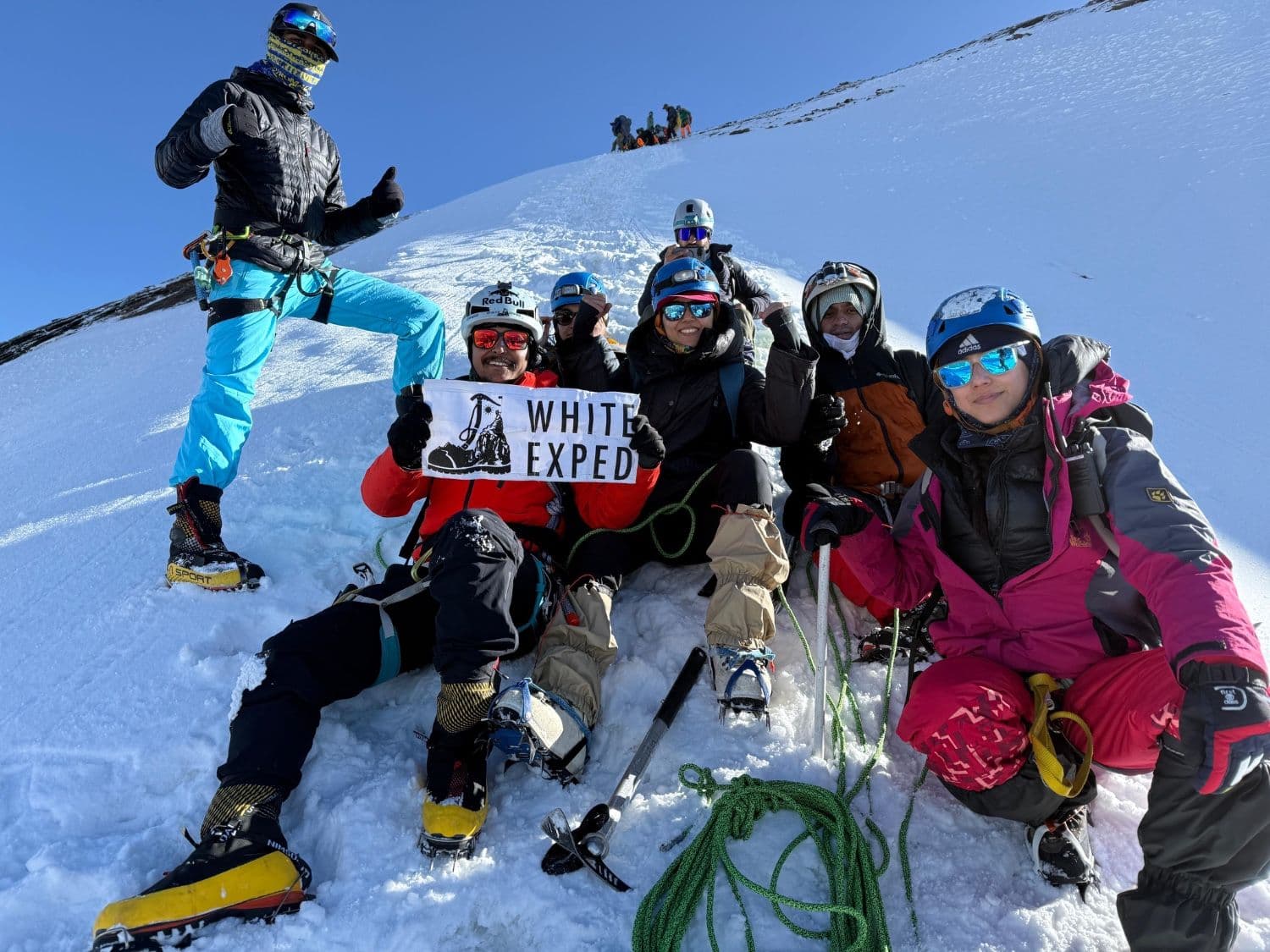
Friendship Peak is not only a walk on a marked trail. Depending on conditions, the route includes moraine, snow slopes, glacier terrain, and rope-managed sections. Participants should be ready to learn and use crampons, an ice axe, harness, and basic glacier-safety systems under the team’s instruction.
3. Summit-day endurance
The published expedition outline describes an early summit start, roughly eight hours of ascent and four hours of descent, followed by a return toward base camp. Timings are route- and weather-dependent. The practical requirement is sustained, efficient movement in cold conditions rather than a short burst of gym fitness.
4. Weather and judgement
Snow, wind, visibility, and route conditions can change the effort required. A responsible team may slow, alter, or stop an attempt. A climber’s suitability therefore includes pacing, communication, and willingness to turn around—not just motivation to reach the summit.
Prerequisites: who is likely to be ready?
There is no universal pass/fail checklist, but a suitable participant should be able to demonstrate:
- Recent high-altitude trekking or equivalent mountain experience, with a realistic understanding of cold, exposure, and long days.
- Consistent aerobic conditioning plus leg and core strength for sustained ascent and descent with a pack.
- Comfort following instructions and moving in a roped team on snow or glacier terrain.
- Enough time to train, acclimatise, and arrive rested rather than relying on last-minute fitness.
- Honest disclosure of medical considerations and previous altitude response to the expedition team.
Someone with no mountain experience, no time to train, or an expectation of a comfortable sightseeing trek should choose a lower-commitment objective first. The final suitability decision belongs with the expedition team after an individual conversation; this guide is not medical clearance.
A practical preparation test
Before enquiring, ask yourself:
- Can I sustain several hours of uphill movement and still descend safely?
- Can I keep a steady pace when cold, tired, or uncomfortable?
- Am I willing to learn crampon, ice-axe, harness, and rope procedures exactly as taught?
- Can I accept an altered itinerary or a turn-around if conditions are not right?
If any answer is uncertain, use the training plan, speak with the team, and consider building experience through a suitable high-altitude trek first.
Friendship Peak compared with a normal trek
Friendship Peak shares an approach environment with Manali treks, but the summit objective changes the demands. A trek such as Hampta Pass or Beas Kund does not automatically prepare someone for crampons, glacier travel, a high summit camp, or a long snow-based summit day. Those experiences can be useful foundations, but the mountain skills still need to be taught and practised.
Is Friendship Peak a good first mountaineering objective?
It can be a sensible first Himalayan mountaineering objective for a fit trekker who is prepared for semi-technical snow and glacier work, has enough time to train, and accepts that the mountain may say no. It is not suitable to describe as “easy,” and it should not be selected on the word “beginner” alone.
For a broader comparison of introductory objectives, visit the guided 5,000m peak category. For the current route, group, and operational details, return to the Friendship Peak expedition page.
Final assessment
Friendship Peak’s difficulty comes from the combination of 5,289m altitude, snow and glacier movement, a long summit day, and changing mountain conditions. Preparation can make the progression more manageable, but it cannot remove the objective’s demands. Treat this page as a readiness framework, confirm current details with White Expedition, and choose the climb only after an honest suitability review.